A Comparison of Business Simulations in Innovation, Marketing, Product Management

A Comparison of Business Simulations in Innovation, Marketing, Product Management

Why simulation-based learning is becoming AI-resistant by design

In times of rapid advances in artificial intelligence, a fundamental shift is taking place in higher education. As AI systems become increasingly capable of generating analyses, solving structured problems, and supporting managerial decision-making, the question is no longer whether students can arrive at the right answers. Instead, the question is whether they are engaging in forms of learning that cannot be easily replicated or outsourced.

Simulation-based learning is gaining renewed relevance in this context.

Unlike traditional assignments, simulations introduce a layer of interdependence that is inherently difficult for AI to resolve. Outcomes are not only determined by models or data, but by the decisions of multiple teams acting simultaneously. Each decision influences the environment in which others operate, creating feedback loops that evolve over time.

While AI can optimize within a predefined system, it struggles to anticipate how that system will change when multiple actors interact dynamically. This makes simulations one of the few educational formats where learning remains fundamentally human: shaped by judgment, timing, interaction, and uncertainty.

A closer look at widely used simulations such as Glo-Bus, Capsim, Marketplace Simulations, Cesim and Markstrat reveals that they differ significantly in what they actually model and therefore in what they teach.

Comparative overview of widely used simulations

Simulation Organizational perspective Thematic focus Primary decision domain Role of innovation Learning orientation Level of abstraction Type of complexity
Glo-Bus Product & market positioning Competitive strategy in technology markets Pricing, production, product features, market positioning Implicit (via R&D and product design) Competitive performance and market positioning Medium Financial and market-driven
Capsim Functional business system Integrated firm management Cross-functional decisions (R&D, finance, marketing, operations) Partial General management and business acumen Medium Analytical and data-intensive
Marketplace Simulations Customer & market interface Marketing strategy and customer behavior Product launch, branding, segmentation, pricing Limited Customer insight and market strategy Medium Market dynamics and positioning
Cesim (Global Challenge) Strategy & external environment Global strategy and sustainability trade-offs Global expansion, strategy, sustainability decisions Emerging Strategic decision-making in global contexts Medium–high Strategic and financial
Markstrat Product portfolio management Marketing strategy and product lifecycle management Product portfolio, segmentation, R&D Moderate Market strategy and lifecycle management Medium Analytical and market-based
Innovation Management Game (Innovative Dutch) Innovation system & organizational design Managing exploration vs exploitation and innovation portfolios Portfolio balance, resource allocation, long-term alignment Central and explicit Innovation capability and strategic alignment High Systemic and strategic

Two fundamentally different logics

At first glance, these simulations appear structurally similar. Teams make decisions in iterative rounds, receive feedback, and compete for performance. Yet beneath this shared format lie two fundamentally different logics.

Most simulations, including Glo-Bus, Capsim, Marketplace, Cesim, and Markstrat, model the organization as a firm operating within a competitive market. The task of the participant is to improve performance within that environment. Success is typically measured in terms of profit, market share, or strategic positioning.

In contrast, the Innovation Management Game operates at a different level. Rather than simulating the market itself, it focuses on how organizations design and manage their innovation system over time.

Most simulations model the outcomes of innovation: products, markets, and performance.
The Innovation Management Game models the system that produces those outcomes.

Innovation Management Game session in practice

What becomes visible in practice is that simulation-based learning is not only about making decisions, but about experiencing how those decisions interact over time. Participants are confronted with uncertainty, conflicting priorities, and the need to align short-term actions with long-term strategy.

This is where the difference between market-based simulations and innovation-oriented simulations becomes tangible. Rather than optimizing isolated decisions, participants must develop coherence across their choices and understand how their actions shape the system as a whole.

The Innovation Management Game explicitly focuses on this dynamic, placing participants in a setting where innovation is not a single decision, but an evolving system of trade-offs.

Market-based simulations: optimizing within a given system

Simulations such as Glo-Bus, Capsim, Marketplace, Cesim, and Markstrat are rooted in a paradigm of optimization. The organization is treated as a system that already exists, and the role of the participant is to make better decisions than competitors within that system.

Glo-Bus illustrates this clearly. Although positioned as a technology design simulation, participants primarily configure products and compete on price, features, and market positioning. Innovation is present, but mainly as a function of product development.

Capsim extends this by integrating multiple business functions. Participants must align decisions across departments, interpret financial data, and manage trade-offs between growth and profitability. The complexity increases, but remains analytical in nature.

Marketplace Simulations emphasize customer-driven decision-making, focusing on segmentation, branding, and product launches. Cesim adds layers of international strategy and sustainability, while Markstrat deepens understanding of portfolio management and product life cycles.

Across these simulations, a consistent pattern emerges: complexity arises from the number of variables and the need to interpret data. The challenge is to optimize performance within a relatively well-defined system.

Designing the system: a different level of decision-making

The Innovation Management Game starts from a different premise. Instead of assuming a fixed system, it focuses on how that system is designed and evolves.

Participants are not primarily concerned with pricing or production decisions. Instead, they must address questions such as how resources should be allocated between exploration and exploitation, how balanced the innovation portfolio is, and how short-term results relate to long-term renewal.

These decisions are inherently systemic. Their impact is often indirect, delayed, and dependent on how different elements of the organization interact over time.

As a result, the nature of decision-making changes. There is no single optimal solution. Instead, participants must develop coherence in their choices and understand how those choices shape the organization’s ability to innovate.

Analytical versus systemic complexity

This difference is most clearly visible in the type of complexity each simulation introduces.

Market-based simulations are analytically complex. Participants are presented with large amounts of data and must identify patterns, calculate trade-offs, and make decisions that optimize performance indicators. The challenge is primarily cognitive and quantitative.

The Innovation Management Game introduces systemic complexity. Outcomes depend on interactions between decisions, timing, and alignment. Cause-and-effect relationships are less direct, and success depends on the ability to understand and manage interdependencies.

This distinction is increasingly relevant. While analytical complexity can often be supported, or even partially automated, by AI, systemic complexity remains difficult to externalize.

Abstraction and learning outcomes

Another key difference lies in the level of abstraction.

Most simulations operate at a relatively concrete level, focusing on products, markets, and financial results. This makes them highly effective for developing business acumen and functional knowledge.

The Innovation Management Game operates at a higher level of abstraction. It focuses on capabilities, processes, and strategic alignment. This allows participants to explore how organizations create value over time, rather than how they optimize performance in a given moment.

The learning outcomes therefore differ. Market-based simulations are effective in developing business acumen and functional knowledge. Simulations focused on innovation systems contribute to a broader understanding of strategy, organizational design, and long-term value creation.

Implications for education

These differences are not merely technical. They reflect broader shifts in how organizations are understood.

Traditional simulations align with a view of organizations as entities competing in relatively stable environments. Success depends on efficiency, optimization, and informed decision-making.

More recent approaches reflect a view of organizations as adaptive systems operating under uncertainty. Here, success depends on the ability to innovate, experiment, and continuously rebalance competing priorities.

In this context, simulation-based learning is not only a way to teach business fundamentals, but also a way to engage with the limits of those fundamentals.

Conclusion

Business simulations are often treated as a single category, but a closer analysis reveals that they operate at fundamentally different levels.

Simulations such as Glo-Bus, Capsim, Marketplace, Cesim, and Markstrat provide valuable insights into how organizations perform within markets. They strengthen analytical thinking, financial reasoning, and competitive decision-making.

The Innovation Management Game operates at a different level. It focuses on how innovation systems are designed, balanced, and evolved over time, shifting attention from outcomes to the mechanisms that produce them.

In an AI-driven world, this distinction becomes increasingly important. As analytical tasks become easier to automate, the ability to think in systems, navigate uncertainty, and design for long-term innovation may well become the defining capability for future professionals.

The question for educators is therefore not which simulation is best, but what kind of thinking they want to develop.

Innovation Excellence Framework: Using ISO 56001 to Manage Quality in Innovation Management Systems.

Innovation Excellence Framework: Using ISO 56001 to Manage Quality in Innovation Management Systems.

Innovation is no longer a solo endeavor. The age of open innovation has arrived, where collaboration across industries, disciplines, and borders is key to addressing global challenges and driving progress. In this dynamic landscape, the launch of ISO 56001:2024 represents a monumental step forward for organizations striving to innovate smarter, faster, and more sustainably.

What Is ISO 56001?

ISO 56001 is the latest international standard for innovation management systems. Its goal is to provide a robust framework for organizations to manage innovation systematically, bridging creativity with structured processes. Unlike earlier approaches that often treated innovation as an isolated activity, ISO 56001 emphasizes integration, scalability, and adaptability—key pillars for open innovation.

But what sets ISO 56001 apart is its potential to harmonize collaboration across ecosystems. It recognizes that innovation thrives when ideas, expertise, and resources flow freely between partners. By aligning organizations around common principles and practices, this standard can make open innovation more accessible and impactful.

Innovation Excellence Framework

The Innovation Excellence Framework is a comprehensive system designed to guide organizations in managing their innovation processes. By incorporating internationally recognized standards, it provides a solid foundation for improving the organization’s innovation capabilities and aligning them with long-term goals.

What makes the Innovation Excellence Framework so powerful is its holistic and integrated approach. By incorporating the full ISO 56000 series, it ensures that your innovation efforts are aligned with international best practices, covering everything from strategy development to execution and performance evaluation.

Organizations that adopt this framework are not just improving their innovation processes; they are fostering a culture of continuous improvement, resilience, and strategic collaboration. This positions them to stay ahead of the competition, adapt to emerging trends, and effectively manage innovation in an ever-changing landscape.

In the infographic, the PDCA (Plan-Do-Check-Act) cycle is integrated with the Operational-Tactical-Strategic layers to visually communicate the interconnectedness of different ISO standards in the Innovation Excellence Framework. Each element represents a different stage or layer in the innovation management process, helping organizations understand how to implement and evaluate their innovation strategies.

The PDCA cycle is a widely recognized approach for continuous improvement and is central to effective management systems. It involves four stages:

  • Plan: Set goals and define processes to achieve them.
  • Do: Implement the plan and execute the innovation activities.
  • Check: Monitor and measure the outcomes to ensure the objectives are met.
  • Act: Adjust processes and strategies based on the feedback to improve future innovation activities.

Each of these stages in the PDCA cycle is color-coded to align with the different ISO standards, making it easier to understand which standard applies to each stage.

The Operational-Tactical-Strategic layers represent different organizational levels at which innovation management is applied:

  • Operational Layer: This is where day-to-day activities take place—focused on implementation, execution, and innovation performance at the ground level.
  • Tactical Layer: Involves mid-level management, which ensures that innovation initiatives are aligned with broader goals and that innovation processes are optimized for efficiency.
  • Strategic Layer: Focuses on long-term innovation strategies, aligning innovation with organizational objectives, vision, and global trends.

These layers align with the PDCA cycle stages, ensuring that innovation management is integrated across all levels of the organization.

Each layer of the PDCA cycle and each stage of the operational, tactical, and strategic levels is represented by a distinct color, which corresponds to specific ISO standards. This color-coding allows viewers to immediately identify which ISO standard is most relevant at each stage or organizational layer. Here’s a breakdown of the colors and the corresponding standards:

  • ISO 56000: This standard serves as the foundational element for all innovation management activities, providing essential vocabulary and principles. It is placed at the Strategic level because it guides overall innovation direction.
  • ISO/FDIS 56001: Representing the Plan phase of the PDCA cycle, this standard focuses on establishing an Innovation Management System (IMS) and its requirements. It applies at the Strategic and Tactical levels to ensure proper alignment between innovation strategy and operational actions.
  • ISO 56002: A complementary standard to ISO 56001, offering practical guidance on implementing an IMS. It supports the Do phase in the PDCA cycle and applies at both the Tactical and Operational layers to guide the execution of innovation processes.
  • ISO 56003: This standard covers tools and methods for innovation partnerships, essential for collaboration across all levels of the organization. It is aligned with the Tactical and Operational layers to ensure collaboration within innovation ecosystems.
  • ISO/TR 56004: Focuses on Assessing Innovation Performance, which ties into the Check phase. It applies at the Tactical and Strategic levels to evaluate how well innovation is performing and identify areas for improvement.
  • ISO 56005: Addresses tools for managing intellectual property during innovation activities. This standard is connected to the Operational layer as intellectual property often plays a central role in day-to-day innovation processes.
  • ISO 56006: Provides tools for strategic intelligence management, focusing on gathering and analyzing market and industry data to inform innovation decisions. This standard fits at the Strategic level, guiding long-term innovation planning.
  • ISO 56007: Focuses on the management of opportunities and ideas, aligned with the Do phase of the PDCA cycle. It supports the Operational layer by providing tools to generate and assess innovation opportunities.
  • ISO 56008: This standard focuses on measuring the operational success of innovation initiatives. It connects with the Check phase in PDCA, ensuring that the Operational layer has the right metrics in place to track innovation progress.
  • ISO/TS 56010: This standard provides illustrative examples of how to apply the ISO 56000 series. It serves as a resource for all levels but does not directly correlate to a single stage of the PDCA cycle or a specific layer.

In summary, the Innovation Excellence Framework based on the ISO 56000 standards offers a proven pathway for organizations looking to manage and optimize their innovation efforts. Whether you’re aiming to improve internal processes, collaborate with external partners, or gain access to funding, this framework provides the tools and insights needed for success.

Why ISO 56001 Matters for Open Innovation

Open innovation—the practice of sharing ideas, technologies, and solutions beyond organizational boundaries—has become a cornerstone of progress. Yet, it comes with its own challenges, including managing intellectual property, fostering trust, and aligning diverse stakeholders. ISO 56001 addresses these barriers in several ways:

  • A Shared Language: ISO 56001 establishes a common vocabulary and framework for innovation. This simplifies collaboration between companies, research institutions, and startups, ensuring everyone is on the same page.
  • Trust Through Structure: Open innovation requires trust, and trust is built on transparency. By providing guidelines for processes like risk management and decision-making, ISO 56001 helps organizations navigate uncertainties collaboratively.
  • Scalability and Adaptability: Innovation ecosystems are diverse, with partners ranging from local entrepreneurs to multinational corporations. ISO 56001’s flexible framework accommodates these differences, enabling seamless collaboration across scales.

Real-World Impact

Consider a biotech company partnering with a university to develop sustainable agriculture solutions. With ISO 56001 as their foundation, both parties can align their objectives, streamline their workflows, and manage intellectual property with clarity. The result? Faster breakthroughs and a stronger impact on global food security.

Or take the example of a city government working with tech startups to build smarter infrastructure. ISO 56001 can guide how these diverse entities share data, integrate their innovations, and create scalable solutions that improve urban living.

A Call to Action for Innovators

The release of ISO 56001 couldn’t come at a better time. As the world faces complex challenges—from climate change to public health crises—the need for open, collaborative innovation has never been greater. This standard offers a roadmap for turning collective ideas into actionable solutions.

For innovators, ISO 56001 is more than a set of guidelines; it’s an opportunity to lead. By adopting the standard, you can position yourself as a reliable partner in the global innovation ecosystem, attract funding, and drive meaningful change.

How to Get Started

Whether you’re part of a multinational corporation, a small business, or an academic institution, ISO 56001 offers something for everyone. Start by:

  1. Exploring the Standard: Learn about its principles, structure, and how it aligns with your innovation goals.
  2. Building Internal Capacity: Train your teams on best practices for innovation management.
  3. Engaging in Dialogue: Use ISO 56001 as a bridge to connect with potential partners and collaborators.

ISO 56001 is more than a technical standard—it’s a tool for shaping the future of innovation. By embracing its principles, we can create a world where ideas flow freely, challenges are tackled collaboratively, and progress knows no boundaries. Let’s innovate together.

Avoid the Toxic Trap: the Toxic Matrix

Avoid the Toxic Trap: the Toxic Matrix

Innovation is the foundation of progress and success in business. A culture of innovation is essential for companies to thrive and stay competitive. One of the biggest challenges for companies is to ensure that the culture of innovation is not overshadowed by a culture of toxicity. There are a number of potential pitfalls that must be avoided in order to create an environment that encourages creativity and collaboration. This blog will discuss these issues, as well as strategies for avoiding the Toxic Trap.

Read more
2 Decades of Open Innovation: an infographic

2 Decades of Open Innovation: an infographic

The rise of open innovation has been a long-standing trend in business. In the early 1990s, companies were starting to realize that they could improve their competitive edge by sharing their ideas and innovations with others. This led to the development of the concept of “open source” software, which allows for free exchange of information among developers. Open innovation is a term first coined by professor Henry Chesbrough in his 2003 book “Open Innovation: The New Imperative for Creating and Profiting from Technology”. It describes the process of organizations leveraging external ideas and resources to drive innovation and growth. This can be done through things like open R&D, corporate venturing, collaborative research, etc.

Read more
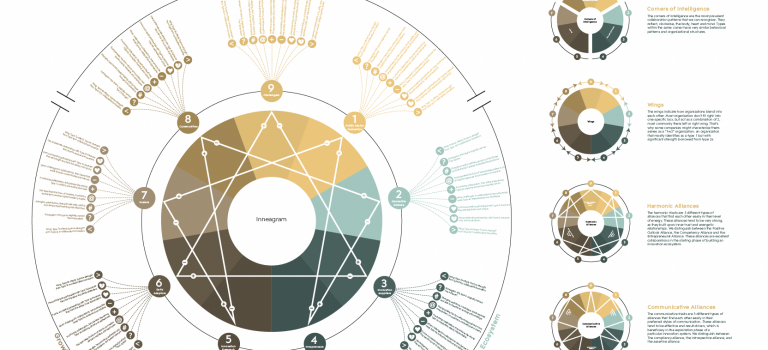
Inneagram: Stakeholder Collaboration in Innovation Ecosystems

Inneagram: Stakeholder Collaboration in Innovation Ecosystems

The story of this infographic began 16 years ago during a Summer School organized by the University of Cambridge. Not in the City of Perspiring Dreams itself, but on the mystical mountain Uludağ in Turkey, with 15 fellow students in a mountain hut more than 1 hour away from the nearest town with cellphone reception. On this mountain, led by Cambridge professor Jim Platts, we took an ESTIEM traineeship in transformative leadership. Without taking a deep dive into the material of the Summer School, one of the models that we started to work with was the Enneagram. Not only the power of the model itself, but also the history behind it, really intrigued me and so the story began.

Over the years, I’ve read much more about the Enneagram. Mostly used in (business) psychology, the framework is best described as an adaptive approach to recognize your own – and others’- behaviour in interactions with others. So it’s not, as many think, a framework for personality traits, like the Myers-Briggs Type Indicator (MBTI) or the Big-5 personality test. It perhaps holds the middle between these personality tests and the Rose of Leary, a theory of behavioral influence. The theory helps you to find your comfort-spot and from there on explains how your interactions with others happen and could be improved if you learn how to read it. It’s adaptable: it may change under different circumstances, under different preconditions and in different situations.

Read more
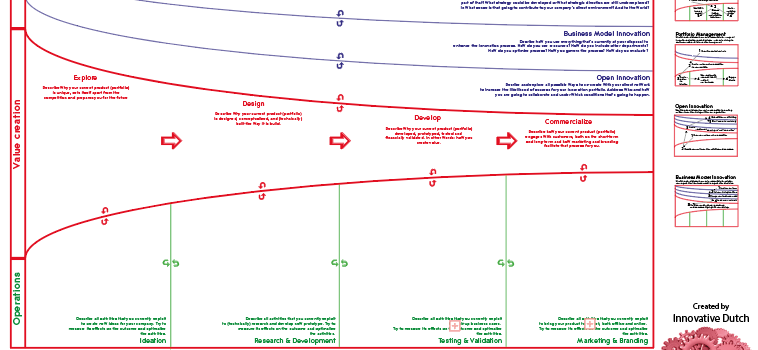
Innovation Management Canvas

Innovation Management Canvas

As part of a simulation game on innovation management we have been running at universities and in corporate training programs for over 4 years now, we have developed an integrative model for dealing with innovation management on a daily basis. Innovation Management is a strategic activity that isn’t necessarily needed to implement throughly for every company. Mostly large companies have included structured processes that include administrative stages to following the (large number of) project that are in progress and to be able to follow-up on them and calculate the effect of innovation management in general. For smaller companies however, that is not general practice: having such a formal process in place simply doesn’t weigh up to cost efficiencies will generate. But for them, innovation management is just as important – but they rather use a toolkit than a formal process. Based on our 8 Types of Innovation Processes model this is a useful canvas design that makes it easy to start working on formalizing your innovation activities and processes in your organization.

Read more

ISPIM Conference Porto & ISPIM Grand Prize for Innovation Management Excellence

As a member of ISPIM, we’re proud to be part of the ISPIM 2016 Conference in Porto again.

Organised by ISPIM, and supported by ANI – Agência Nacional de Inovação (the National Innovation Office of Portugal), this event is for innovation researchersindustry executivesthought leaders and policy makers.

  • Understand the latest innovation management thinking in 50+ workshops, keynotes, tours and discussions
  • Broadcast your insights to 500 innovation experts from 50 countries
  • Get feedback, get published and share understanding
  • Deep dive into the Portuguese innovation scene
Read more
Trending Topics in Innovation Management

Trending Topics in Innovation Management

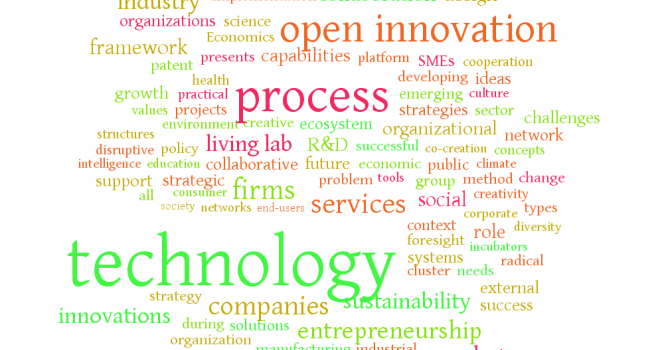
Last week, 233 papers have been presented at the ISPIM conference. Although not proceeded yet, the papers and abstracts are already available for ISPIM members. Being a member, I was able to scan all the abstracts, titles and keywords for trending topics. After a few manual adjustments, such as combining words and ignoring research-related terminology I could come up with the following wordcloud. It identifies the main topics that are currently trending in innovation management. Read more

5 Most Powerfull Insights on Innovation Management gained at the ISPIM Conference

5 Most Powerfull Insights on Innovation Management gained at the ISPIM Conference

“If you go from Moscow to Budapest, you think you are in Paris. And if you go from Paris to Budapest, you think you are in Moscow,” as Gyorgy Ligeti very sharply noticed, perfectly describes the location of the XXVI ISPIM Conference in Budapest. ISPIM, short for International Society for Professional Innovation Management, organized this worldwide event once a year. A place to be for everyone involved in Innovation Management, both practitioners and scholars.

Read more
4 ways in which ideas management helps innovation flourish

4 ways in which ideas management helps innovation flourish

Ideas management could, according to this article, support the innovation process in four ways:

  • It helps organisations to capture, evaluate and progress proposals
  • It provides a democratic environment to determine the best ideas and to show a willingness to consider all ideas
  • It helps to increase genuine cross-organization transformation
  • It helps in creating a corporate shared view on key activities

It may be an advertorial, but at least it provides a nice overview of an under-researched element of the innovation process.

Read full article: 4 ways in which ideas management helps innovation flourish